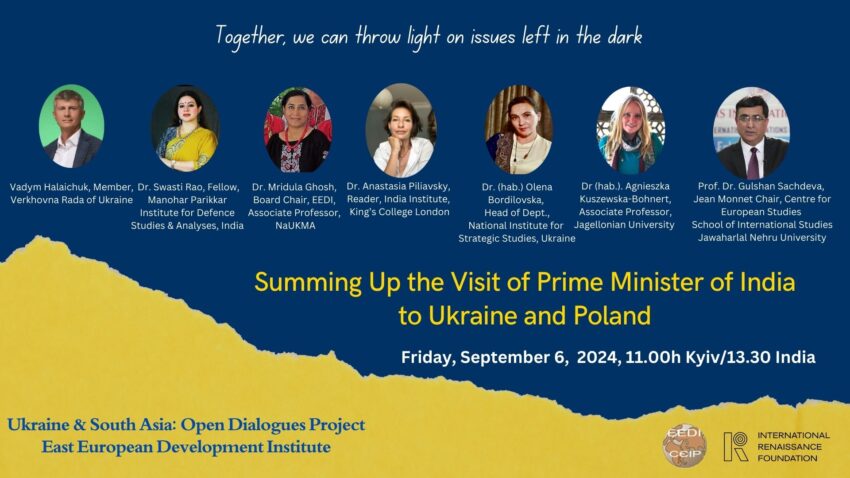
Both ahead of as well as following the visit of the Prime Minister of India Shri Narendra Modi to Ukraine on August 21-23, 2024, to Poland and Ukraine, the East European Development Institute hosted two online discussions summing up the expectations, results and broader impact of the visits, within the framework of its project “Ukraine and South Asia: Open Dialogues”, supported by the International Renaissance Foundation. The discussions were held on 18 August and 6 September respectively.
The first ever historic visit by any Prime Minister of India since the establishment of diplomatic relations between India and Ukraine in 1992, saw, inter alia, signing of four memoranda and a joint statement of leaders. The visit to Poland after 45 years of gap also shows that this visit was historical in new, democratic, post-socialist Poland.
What are the potential areas of cooperation that will benefit Ukraine and India and also Poland and India in the respective bilateral contexts?
What strategic configurations we may see in India’s foreign policy in Central and Eastern Europe?
What immediate effect will the visit have on the peace conferences initiated by Ukraine?
These and other issues will be addressed by our distinguished panel of experts.
Our distinguished panel of experts were: H. E. Dr. Olexander Polishchuk, Ambassador Extraordinary and Pleanipotentiary of Ukraine to India; Mr. Vadym Halaichuk, member of the Verkhovna Rada (parliament) of Ukraine, from the “Servant of the People” faction and the First Deputy Chairperson of the Committee on Integration of Ukraine into the EU, Co-chair of the Parliamentary Committee of the Ukraine-EU Association;
Dr. Swasti Rao. Fellow at the Europe and Eurasia Centre, Manohar Parrikar Institute for Defence Studies and Analyses (MP-IDSA); Dr Anastasia Piliavsky, Reader in Social Anthropology and Politics at the India Institute of King’s College London; Prof Gulshan Sachdeva, Jean Monnet Chair; Coordinator, Jean Monnet Centre of Excellence; and Professor at the Centre for European Studies, Jawaharlal Nehru University; Dr. Olena Bordilovska (Dr.Habil.), Head of the Department of New Challenges at the National Institute for Strategic Studies, Kyiv; Prof. Agnieszka Kuszewska-Bohnert (Dr. Habil.), political scientist, Associate Professor at the Institute of Middle and Far East, Faculty of International and Political Studies, Jagiellonian University in Krakow and Dr. Mridula Ghosh, Associate Professor, NaUKMA and Board Chair, EEDI.