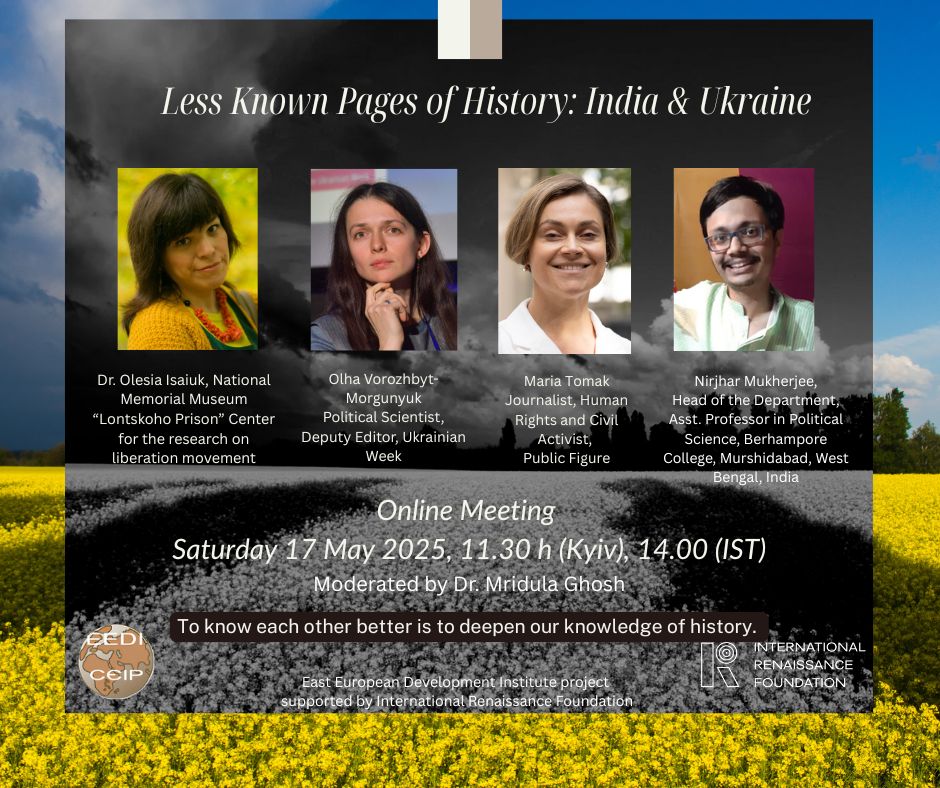
Events during World War II shaped today’s world to a great extent. However, irrespective of the overall recognition of Nazi crimes, there were issues that remained unresolved and ambiguous. Both in the west and the east of Europe, several facts are being revealed with regard to the role of Stalin’s USSR, which was an ally of Nazi Germany in starting the war in 1939. Furthermore, the underground liberation movements were active all over the world, in the occupied countries of Europe as well as in the remote colonies in Africa and Asia. Existing narratives failed to do justice, overlooked or suppressed facts. What was happening in Ukraine? What was the role of the Ukrainian Insurgent Army? Who were the leaders? Indians have almost no knowledge of these facts. Similarly, what was happening then in India? Did India only win independence by non-violence? Who was Subhas Chandra Bose? Why did he escape British prison and meet Hitler? What was the role of the Indian National Army that he created in the freedom struggle of India? There is scanty knowledge of these facts in Ukraine. An online discussion was held under the aegis of the EEDI project “Ukraine and South Asia – Open Dialogues 2.0” supported by the International Renaissance Foundation on May 17, 2025 at 11.30 (Kyiv), 14.00 (IST).
Our key speakers are:
Dr. Olesia Isaiuk, National Memorial Museum “Lontskoho Prison” Center for the research on liberation movement
Nirjhar Mukherjee, Head of the Department, Asst. Professor in Political Science, Berhampore College, Murshidabad, West Bengal, India
Olha Vorozhbyt-Morgunyuk, Political Scientist, Deputy Editor, Ukrainian Week
Maria Tomak, Journalist, Human Rights and Civil Activist, Public Figure
Dr. Mridula Ghosh, EEDI Boad Chair, moderator
Also participating in the discussion is our guest Ms. Monami Nag, NET, M.Phil, author and researcher, Principal, A. P. Nagar Atulkrishna Roy Vidyayatan, Kolkata, India