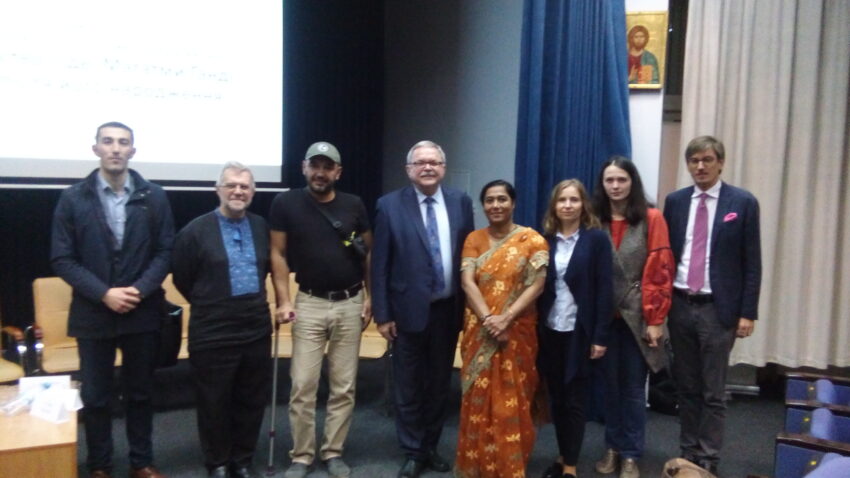
On the occasion of the 150th anniversary of Mahatma Gandhi’s birthday, on October 15, 2019, the Institute of Ecumenical Studies of the Ukrainian Catholic University (IES, UKU), together with EEDI, held a round table on the topic: “Nonviolence? Mahatma Gandhi’s ideas 150 years after his birth”, with the participation of the leadership of IES, UCU, teachers, scientists, researchers, public figures, media representatives and students.
Mahatma Gandhi’s role in leading non-violent resistance for the liberation of India has received great recognition in the world. Since 1947, every year, this day is a holiday in India. Decades later, on June 15, 2007, the UN General Assembly adopted a resolution to celebrate Mahatma Gandhi’s birthday on October 2 as the International Day of Nonviolence. The resolution confirms the “universal importance of the principle of non-violence”, as well as “the desire to establish a culture of peace, tolerance, understanding and non-violence”. This day was celebrated for the first time in 2007 in the world.
This round table is special – in space and time. The time is 2019, the jubilee year – the 150th anniversary of Gandhi’s birthday. Space – Ukraine is a country in the heart of Europe that experiences the horrors of violence and aggression every day from its neighbor Russia. It is more important that, despite all the troubles of violence on the fate of Ukraine, Mahatma Gandhi is a deeply respected figure for Ukrainians, and the principles of non-violence are highly significant. The most important thing is that the round table will take place within the walls of UCU, which is a leading educational institution that professes the thousand-year-old Christian principles of non-violence, which Gandhi especially respected. In the speeches of outstanding specialists, you will hear the relevance of non-violence today, in the age of terror, in the age of post-truth and hybrid war.
Among the participants was Myroslav Marynovych, a well-known human rights defender and public figure, highly respected in Ukraine and in the world. His speech “Nonviolent resistance in Ukraine: an echo of traditions and specific challenges” revealed nonviolence as a social and moral phenomenon in Ukraine. Mitr. Prot. Dr. Mykhailo Dymid, professor of the Department of Pastoral Theology at UCU continued this spirit through the topic “Maidan and the meaning of nonviolent resistance”. The report on “Violence and non-violence in Christianity and Gandhi’s views” was extremely interesting. Dr. Oleg Kindia, professor of the Department of Theology at UCU. Representatives of SEIR also spoke. Expert Olha Vorozhbyt-Morgunyuk on the topic “Gandhi in the post-truth era” and head of the board Mridula Ghosh on the topic “Post-colonial era and Gandhi: relevance for Ukraine”. Nonviolent resistance as a systematic method of political struggle for the Crimean Tatar people during the USSR and in our times is important to remember. This was emphasized in the report of Alim Umerozha, representative of the Crimean Tatar community in Lviv. Dr. Pavlo Smytsnyuk, director of the Institute of Ecumenical Studies of UCU, spoke about the spiritual values of nonviolence. He also moderated the discussion.
Since 2007, EEDI has been holding the campaign “An eye for an eye makes everyone blind” on the occasion of the International Day of Nonviolence (October 2) – Mahatma Gandhi’s birthday in Ukraine, and has been holding the Week of Peace and Nonviolence on the occasion of Vaclav Havel’s birthday (5 October) and John Lennon (October 9). This event was held for the first time in Lviv, thanks to the support of UCU.