The year 2019 marks two grim events in the history of Crimea, and especially for the Crimean Tatar people, indigenous people of the Crimean peninsula. First, the 75th anniversary of mass deportation in 1944 by Stalin, and second, 5 years since Crimea was occupied by Russia in February 2014. Disregarding more than 400 international legal acts, violating international treaties, Russia began the process of occupation of the Autonomous Republic of Crimea and the city of Sebastopol, both integral parts of the unitary state of Ukraine, by covertly sending its armed forces without any insignia, followed by a pseudo-referendum, as an attempt to formalize the occupation and annex Crimea as a part of the Russian Federation. Majority of the countries of the world, except a few, did not recognize this occupation. In the course of the past five years, several resolutions on Crimea were adopted by the UN General Assembly, many resolutions on Human Rights and the situation of the Crimean Tatar people were also passed by the European Parliament. Numerous debates were held within the framework of the UN Security Council, many reports have been published by national and international Human Rights organizations, which clearly state the fact of occupation of the peninsula by Russia and the latter is mentioned as the state-aggressor. Russian aggression was not limited to the occupation of Crimea. In early 2014, through massive and all-encompassing aid to separatists-rebels in the Donbas area of Ukraine, and soon after, through direct deployment of Russian military supervisors, humanitarian aid convoys carrying arms and ammunitions, Russia started its hybrid war in east Ukraine. About four hundred kilometers of the Ukrainian border, parts of Donetsk and Luhansk oblasts of Ukraine, including two major cities of Donetsk and Luhansk are not under Ukraine’s control. More than eleven thousand casualties among Ukrainian service personnel alone (excluding disappearance and death of many civilians) till the end of 2018 and massive displacement of people from Crimea as well as from Donbas has resulted into a humanitarian crisis, unseen in Europe since many decades. To add to this is the propaganda and information war, aimed at demoralizing the democratic set-up of Ukraine and other states, supporting Ukraine. Innumerable initiatives are undertaken to cope with this grave situation, to support the more than million displaced people, to provide urgent aid, shelter, and basic needs. Along with this, Ukraine also has invested its resources into building defense, a strong army and confronted the information war. The situation in Donbas and Crimea are different, although Ukrainian citizens are living in both places and are crossing the check posts to come to Ukraine. Donbas is formally not occupied, it is under rebel control, but the war is in active phase. Crimea is officially under illegal occupation by Russia. Russian law enforcement are fully in control of the peninsula today. Therefore, liaison with Donbas and Crimea and collection of information has different patterns. Consequently, strategy of return of Crimea into Ukraine will have its specific strategy, different from that of Donbas.
Before the occupation and shortly after, people of Crimea were promised improvement of living standards and well-being by Russian administration, and this was the Russian strategy to obtain their votes in favor of annexation in the staged referendum. Five years have passed and it is high time to analyze the situation in Crimea from at least three angles – military strategic, political and legal, and finally cultural, historic and humanitarian.
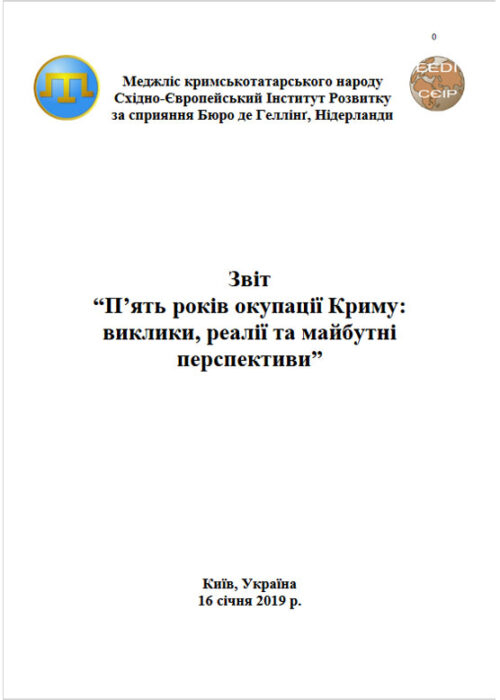
It is with these aims in mind that on 16th January 2019, a Conference was organized in Kyiv, jointly by the Mejlis of the Crimean Tatar people and the East European Development Institute, a Ukraine-based NGO with support from the Bureau De Helling (The Netherlands). The Conference, first of its kind in this commemorative year, consisted of three panel discussions: Crimea as a military base for the aggressor and grey information zone, lawlessness in Crimea and Crimea, as a territory, where the cultural heritage is being destroyed. These violations are mostly targeted towards the indigenous people of Crimea, the Crimean Tatars, their cultural and historical heritage.
In his opening remarks, Serhiy Kurykin, EEDI Board member underscored the importance of discussing the above issues and said that only by stock taking and analyzing the impact of occupation on Crimea, can any viable strategy of return of Crimea to Ukraine be charted out.
He also said a publication consisting of all conference papers and a summary report will be made available in both print and electronic forms.
The present report is a record of the proceedings of the Conference and analysis of the presentations made by individual panelists. Conclusions and recommendations are made at the end for further work by the organizers and other stakeholders.
The Conference was organized by the East European Development Institute, jointly with the Mejlis of the Crimean Tatar People, with support from Bureau de Helling, Netherlands. Author of the Report: Mridula Ghosh
Click below to download a PDF version of the report: